
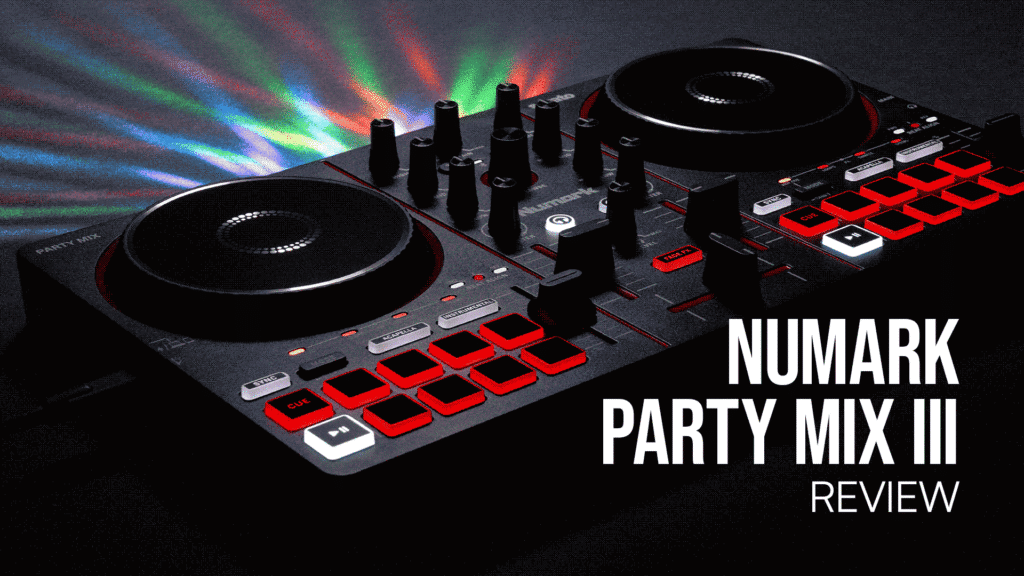
The Numark Party Mix series of controllers has been lighting up (literally) parties and bedroom studios for years now. It’s a super fun and accessible DJ controller that gives you pretty much all the controls you need, loads of compatibility options and, most notably, some cool lights that flash in time to your tunes. But is this party-in-a-box actually a serious bit of beginner DJ gear or just a fun gimmick?
Numark Party Mix III Video Review
Design and Build
The Party Mix III is built to be portable but it’s much less cluttered and crammed than the super compact controllers like the MixTrack Go. Everything is still laid out more-or-less where it should be just shrunk down to a smaller size. It weighs in at just 1.1 kg and features a desktop footprint of 339x205x47mm. Everything is of course purely plastic but the build quality is fairly solid and you can imagine this will survive a fair few parties.
The standout feature of this controller is of course the built-in light show on the rear panel. Three LED balls project out coloured lights in sync to the music. You can use the mode button on the left panel to cycle through five different lighting settings: color-controlled, beat-controlled, fixed-timing random, all on, or completely off. It’s not going to replace your high-end DJ light-system any time soon but it’s surprisingly bright and makes a real impact in a darkened room.
Decks and Mixer
The decks feature capacitive, touch-sensitive jog wheels that are nice and responsive. Of course they’re fairly small so don’t expect that they’ll be great for scratching but for everything else, they won’t be an issue.
A big advantage with the Party Mix III compared to a lot of its compact, budget competitors is that you get a proper, full mixer section. In the middle, there is a full 3-band EQ (High, Mid, and Low knobs) alongside a dedicated Filter knob for each channel.
Beat-Matching Tools
As the Party Mix is aimed squarely at beginners, you get a couple of handy tools to help you learn beatmatching. Around the jog wheels, you’ll find three LEDs which light up with visual feedback to show you whether your track needs nudging backwards or forwards. When everything’s lined up right the centre one lights up. This is a useful aid when you’re starting out but like with any visual tools for beatmatching, we would recommend you don’t rely on it, and it’ll only be as accurate as your beat grids.
Performance Features
The Party Mix isn’t just a flashy light show for beginners though. You still get a decent amount of performance tools to let you do some fun, creative mixing. Under each deck, you’ll find eight performance pads which you can switch between:
- Hot Cue
- Loops
- FX
- Sample
- Stems
Following the trend we’re seeing on a lot of new gear, including the new Numark stuff, Stems controls are included right there on the unit. This lets you isolate the acapella and instrumental of any track with the dedicated buttons, allowing you to create mashups and remixes on the fly.
As well as this, you also get the Fade FX button, which makes the crossfader automatically apply effects to your mixes and lets you pull off smooth transitions super easily. It’s great that tools like this can make mixing so accessible to beginners or non-DJs but, of course, it’s more limited compared to a proper effects section.
Connectivity
All your audio inputs and outputs sit cleanly on the side panels to keep the main interface clear. The right side panel features a 1/8-inch main output for routing audio to your speakers and a 1/8-inch headphone output, which has a cue level on the top. On the left, you get a USB-C port for power supply and connecting to your laptop/phone.
You can also use the Party Mix wirelessly via Bluetooth which allows youn to connect it to a mobile device running compatible software like Algoriddim djay. However, when you do this, the controller’s physical audio outputs are disabled and all the audio runs through your device.
Is It Worth It?
If you are looking for a simple and fun bit of kit to get started on, the Party Mix III offers a lot of value. With the light show on the back, it would be easy to write this off as a novelty gimmick or a toy for kids, but its feature set shows that it’s actually a surprisingly capable controller.
Unlike quite a lot of entry-level gear, you get a proper 3-band EQ, eight performance pads, and dedicated hardware stems buttons so you won’t feel too restricted too quickly when you’re learning to mix. The only real let down is a missing effects section, but at this price point sacrifices always had to be made.
The closest competitor would probably be the AlphaTheta DDJ-FLX2 which also makes some similar compromises in features, so a lot of the decision process will come down to how much you care about the lights or AlphaTheta’s rekordbox ecosystem.
Numark Party Mix III: Key Specifications
| Price | £119 |
| Dimensions (W x D x H) | 339 x 205 x 47 mm |
| Weight | 2.43 lbs. (1.1 kg) |
| Audio Outputs | 1x 1/8″ (3.5 mm) TRS Main Output, 1x 1/8″ (3.5 mm) TRS Headphone Output |
| Audio Resolution | 24-bit / 48 kHz |
| Wireless Connectivity | Bluetooth Low Energy (BLE) |
| Power Requirements | USB Bus-Powered or External USB Adapter (5V, 500 mA minimum for Bluetooth) |
Pros and Cons
| Pros | Cons |
| Built-in LED party lights offer an instant, beat-synced visual show for house parties. | Slightly bulkier footprint compared to ultra-slim pocket travel rigs. |
| Proper 3-band EQ and Filter section per channel for traditional mixing workflows. | Physical audio outputs are disabled when using wireless Bluetooth MIDI control. |
| Hardware Beat Align LEDs provide an excellent visual aid for learning manual beatmatching. | Main and headphone outputs use 1/8-inch connections, requiring breakout adapters. |
| Eight performance pads per deck provide full access to cues, loops, and sampler layouts. | Requires an external power supply with a minimum 5V, 500mA rating if using Bluetooth. |