
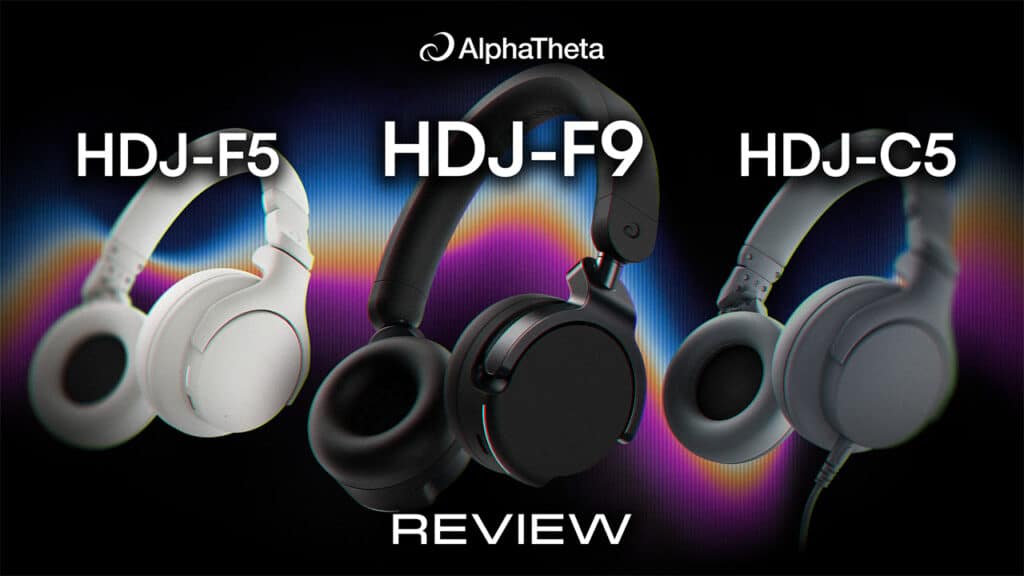
AlphaTheta’s been real busy on the headphone front lately, and in the space of a couple of months, it’s dropped three new pairs. We’ve got the HDJ-F9, a premium on-ear pair (£329), the HDJ-F5, a more affordable over-ear option (£199), and the HDJ-C5 (£99), which is basically the F5 without the wireless.
The F9 and F5 both use SonicLink, AlphaTheta’s low-latency wireless that’s fast enough to actually mix on, unlike Bluetooth. It’s the big selling point of the range, but it also bumps the price up a fair bit, so the real question is whether it’s worth paying for.
We’ve spent some time mixing on all three to find out.
HDJ-F9
Build and design
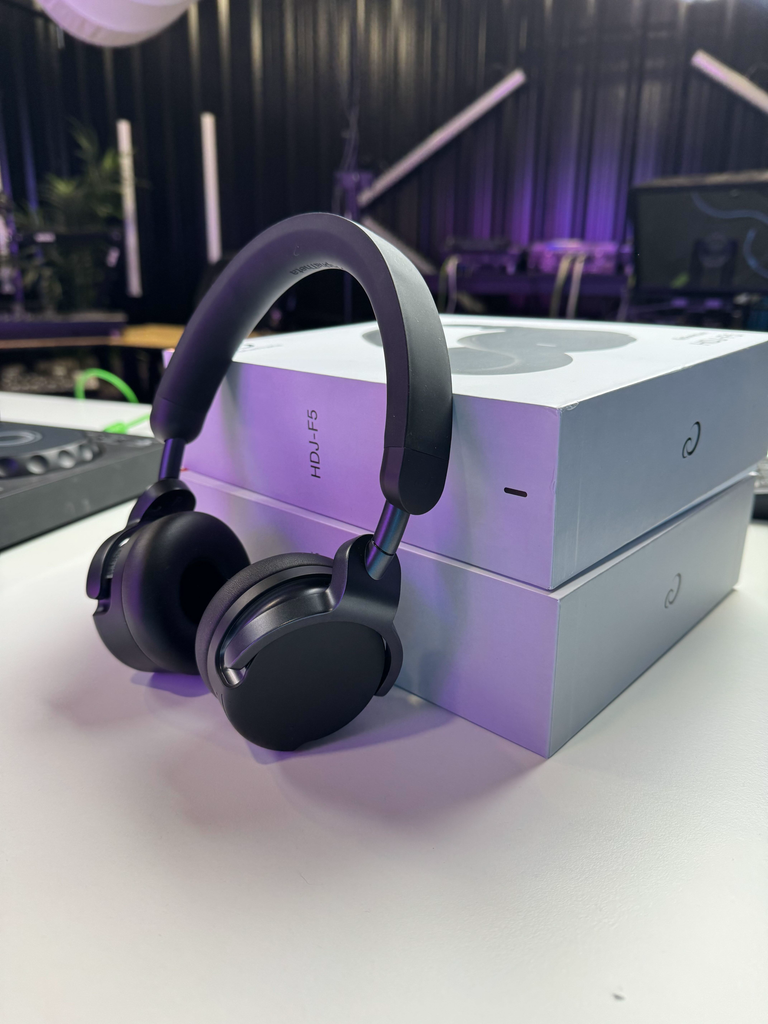
When you first pick up these headphones, they definitely feel like a premium item, which is to be expected at this price point. They’ve got a good heft to them at 285g, and that’s largely thanks to the die-cast aluminium slider. This also makes moving the earcups around nice and smooth. Overall, they feel like they could comfortably withstand the rough life most DJ headphones have to endure.
Looks-wise, it’s clean and minimal with a fairly luxurious feel. Outside the booth, it could easily pass for any other premium pair of headphones rather than screaming DJ gear.
In the box, there’s a coiled cable that stretches from 1.2m up to around 3m for when you want to use them wired, along with a screw-on 6.3mm adapter and a carry pouch. At this price, you might expect a hard case that would really give you some proper protection. This is especially important as the F9s don’t fold flat for storage.
Comfort
Comfort is where the F9 is a bit more of a mixed bag, and it’s a trade-off for the great sound and isolation. The clamp force is strong, which does have its benefits. They stay put on your head even when you’re moving around, and that firm fit makes them great at blocking out noise in a loud booth (more on that in a bit).
For DJing, the tight clamp isn’t really an issue. Most of the time, you’re taking them on and off between mixes, so they’re never pressed on your head for long. It’s more noticeable when you’re wearing them for longer stretches, like listening to music on the go or using them for production. After a while, that pressure starts to get uncomfortable. Most on-ear headphones can have this issue, as they press directly on your ears, but the F9 does feel tighter than most. If you’re planning to use them as your everyday headphones, and especially if your head’s on the larger side, it’s worth bearing in mind.
Sound and isolation
Sound-wise, the F9 is really impressive. AlphaTheta has used newly developed 40mm drivers here, along with a bass-reflex chamber at the top of each housing that’s designed to tighten up the attack of kicks and basslines, and you can hear it. There’s loads of detail, and the bass response sounds properly tight and well-defined. That’s especially good for DJs, where you want to be able to pick out the kick and bass easily when you’re beatmatching.
It’s not a neutral, studio-style sound, though. Like most DJ headphones, the F9 leans quite heavily towards the bass. That’s not a criticism, as it’s what you want when you’re trying to hear the beat over a loud system, but it’s not the pair to reach for if you want a flat, accurate sound for mixing down tracks. That punchy bass won’t be to everyone’s taste for everyday listening, and I found it a little fatiguing for extended sessions, but that’s largely personal preference.
They also go plenty loud, with an SPL of 106dB (in non-techy terms thats more than enough to hear your tunes in the booth). Isolation is especially good for an on-ear design. On-ear headphones usually struggle here because they sit on your ears rather than sealing around them, but the F9 does a great job of blocking out the sound in the booth (or the chatter in the Crossfader office).
SonicLink
The big selling point of the F9 is SonicLink, AlphaTheta’s own wireless tech. Normal Bluetooth has too much delay to beatmatch with, but SonicLink gets latency down to as low as 9ms. Like we found with the older HDJ-F10, mixing on these is basically just like with a wired pair and you don’t notice any latency at all.
At the moment, SonicLink is just built into the XDJ-AZ, XDJ-AN, DJM-A7 and DJM-V5. With this gear you can use the inbuilt transmitter to connect directly to the headphones. For everything else, you need the special HP-TX01 transmitter, which is sold separately for £109. That brings the total to £438, which is very steep for DJ headphones.
On SonicLink, the battery life is around 7 hours, or 9 with the status light off, which is plenty for most gigs. Overall, it’s impressive and we’ve found that it works exactly as promised, but we’re still yet to be convinced of just how useful it is in a real-world scenario.
Everyday listening
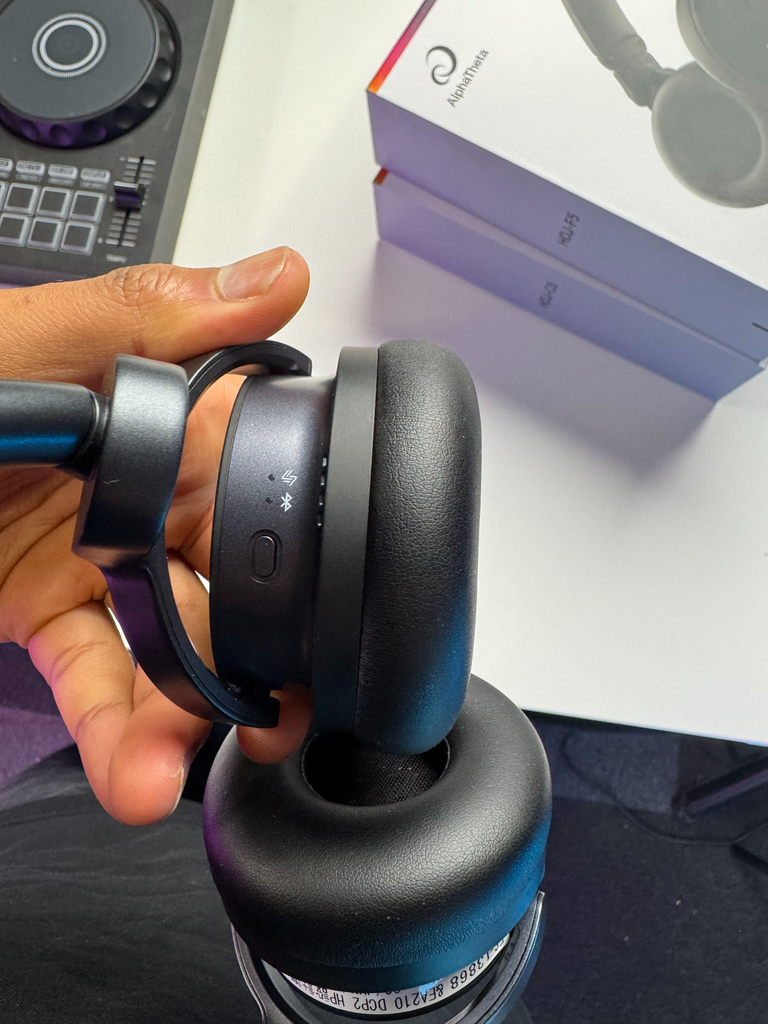
Away from the decks, the F9 also works as a normal pair of Bluetooth headphones. It can connect to two devices at once, like your phone and laptop, and there’s a built-in mic for calls. Battery life on Bluetooth is around 13 hours, or up to 25 with the status light off.
However, there’s no active noise cancellation and, as mentioned earlier, the tight clamping for isolation can get a bit uncomfortable after a while.
Verdict
If you’re after a pair of on-ear DJ headphones with a money-no-object budget, this is the pair to go for. Even beyond the wireless tech, they’re fantastic cans with really top-tier sound and a build quality that helps to justify the high price. We’re still not so sure how much value the wireless offers, and if you’ve not already got SonicLink gear, it’s
HDJ-F5 and HDJ-C5
We’ve put these two headphones together because, as far as we can tell, the only real difference between them is that the C5 (£99) is wired and the F5 (£199) is wireless. AlphaTheta says they share the same sound, isolation and durability, and after using both, we’d agree.
Design and Build
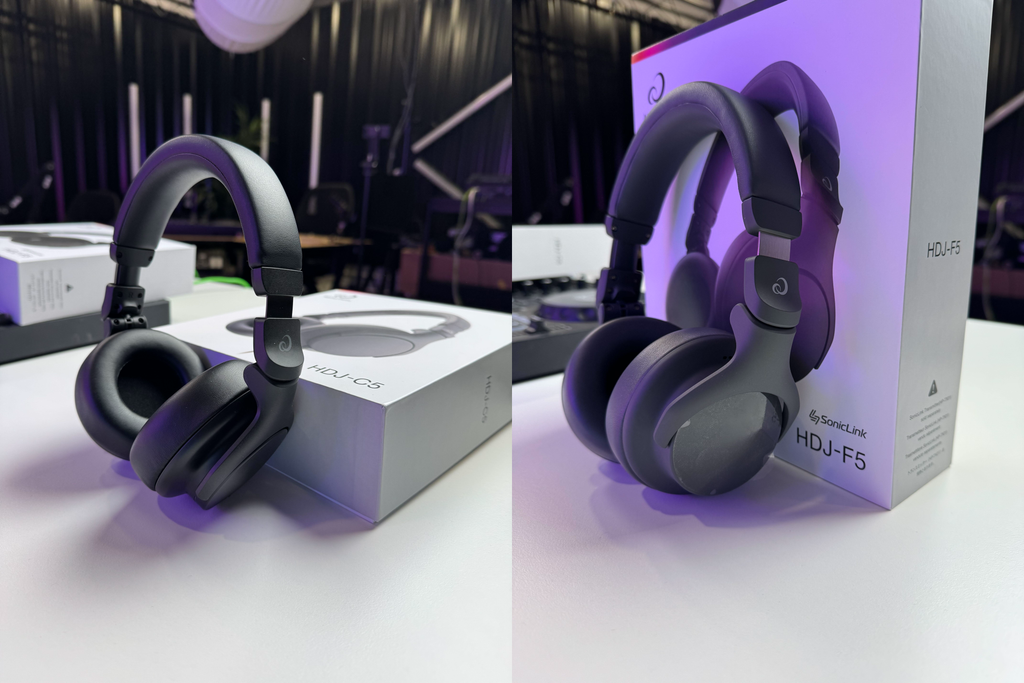
Both are over-ear, which makes them noticeably comfier than the F9 for longer sessions. The cups sit around your ears rather than pressing on them, so they’re much better if you want to wear them for hours listening to music or producing.
The build is one place where you can tell these are the more affordable options. They feel a bit plasticky and cheap in the hand. It’s by no means terrible, and they don’t feel flimsy, but there’s a clear step down from the F9. They both come with a 1.6m straight cable and fold flat for storage.
The F5 weighs in at 291g and comes in black or light grey. The C5 is a bit lighter at 249g, thanks to not having all the extra battery and electronics, and it only comes in dark grey. You don’t get a case with either of them, which is a shame.
Sound and Isolation
Both models sound the same and must be using the same drivers powering them. Like the F9s, and as you’d expect from DJ headphones, the sound is bass-heavy, which makes it easy to pick out the kick when you’re beatmatching but might not lend itself to production. They definitely don’t have the same level of detail or control as the F9, which is to be expected, but they still sound solid. At £99, the C5 probably offer pretty good sound quality for the money, but the £199 F5s have some stiffer competition in that regard.
Wireless
The F5 uses the same SonicLink tech as the F9, and it worked just as well, with no noticeable lag. It also has touch pairing with the DJM-A7 and DJM-V5, and Bluetooth for everyday listening, which is fine but nothing special.
The same transmitter catch applies, though. If your setup doesn’t have SonicLink built in, you’ll need the £109 HP-TX01, which takes the total to a pretty hefty £308.
Verdict
As the sound and build are the same, the extra £100 (or extra £209 with transmitter) for the F9 is purely for the wireless tech. If you’ve already got a rig that supports SonicLink and you’re sold on the idea of going wireless, then this is the cheapest way into that. But once you start adding on the transmitter, the AIAIAI TMA-2 DJ Wireless works on the same concept and (to me) offers better build and sound at a lower cost.
The C5 though, is the one we’d have a much easier time recommending. They’re just a pair of simple, no-nonsense DJ headphones that sound good, are well-built enough not to worry us and come in at a pretty reasonable price.
The stiffest competition will come from the Pioneer HDJ-CUE1. We love these headphones and at £59 give you that brief of a basic, reliable but quality pair at an even lower price.