

For two decades, Pioneer’s CDJs have set the bar for professional DJ players. Walk into almost any club or festival, and you’ll see a pair of them in the booth. However, despite their dominance, they’re not the only DJ players on the market, and Denon DJ has been steadily trying to make waves, with their own feature-packed value-oriented players.
The launch of the AlphaTheta CDJ-3000X makes the comparison with Denon’s SC6000 Prime more relevant than ever. Both are professional-level decks with large touchscreens, lots of performance features, and connection options. But they come in at wildly different prices, have a few key differences and serve pretty separate audiences.
So, let’s take a closer look at how they compare and consider which might be the best choice for you.
Screen & Workflow
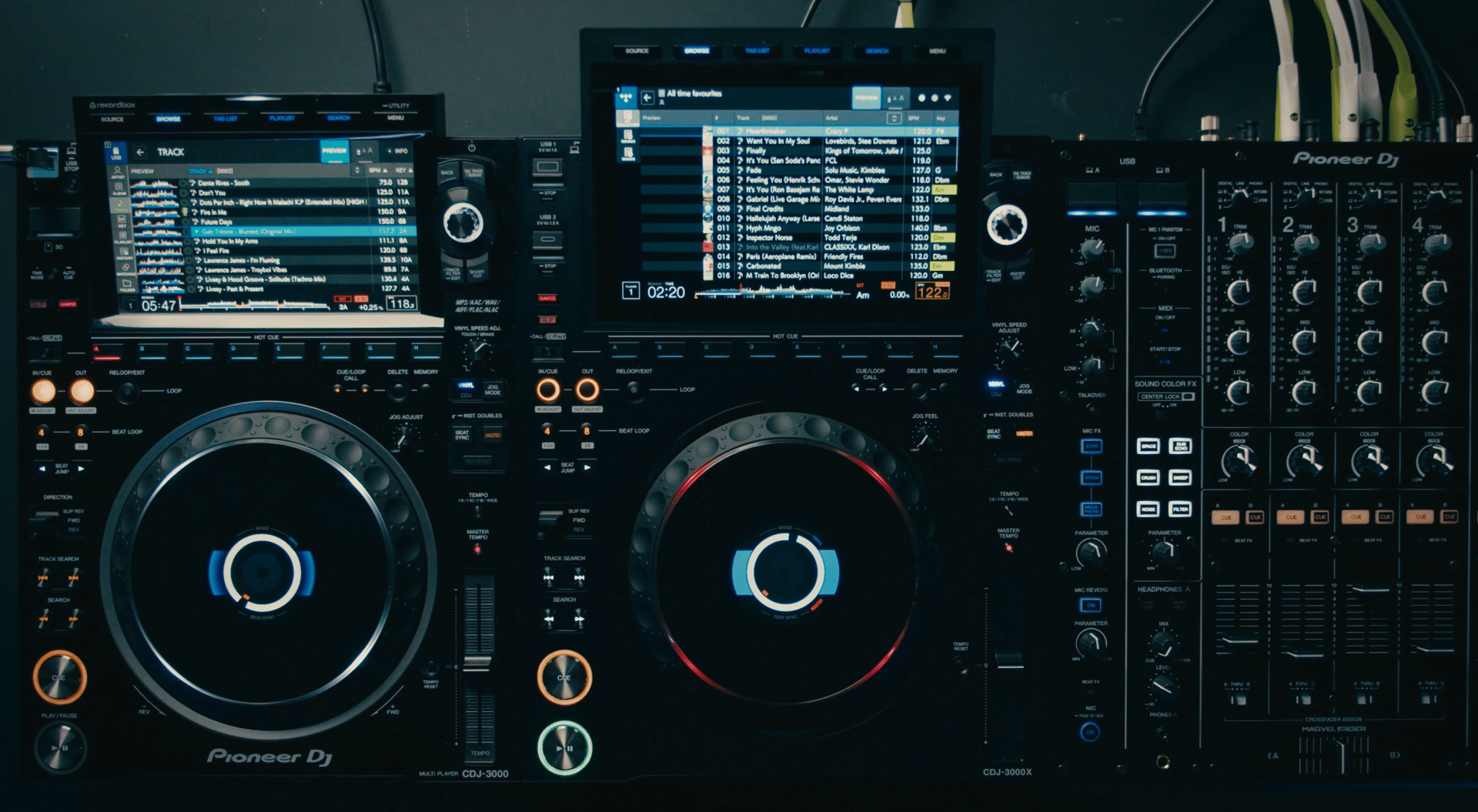
The CDJ-3000X delivers a slick, 10.1-inch display designed to clearly show you what’s going on in your tracks and help you find tunes as fast as possible. Browsing is fast and reliable, searching is intuitive, and rekordbox integration makes moving between laptop prep and club gear effortless. Track caching makes sure that the music keeps playing even if your USB or Wi-Fi connection fails. Everything here is about precision and reliability under pressure. It’s also got Pro Club Link to easily connect it up with other AlphaTheta gear.
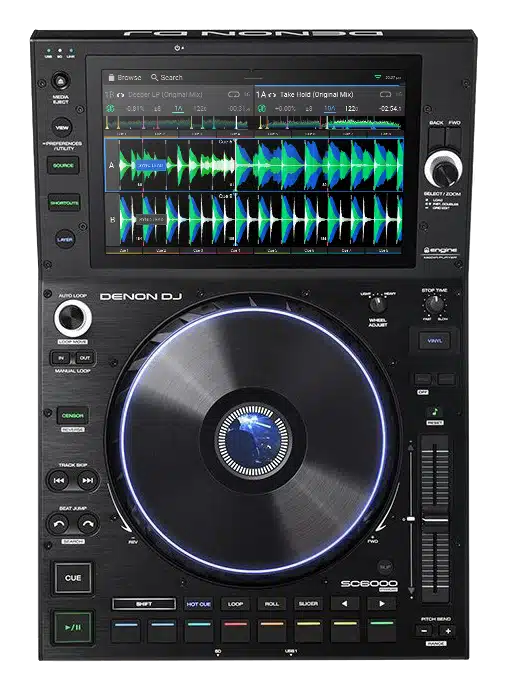
The SC6000 also has a sharp 10.1-inch screen, but its workflow leans towards flexibility. Dual-layer playback means one unit can run two tracks at once, with the display showing both layers side by side. Layout options are more open-ended, too, giving you extra ways to view and manage your library directly on the player. It’s powerful in a personal setup, though without rekordbox integration, the workflow doesn’t carry over into a professional booth in the same way.
Verdict: The CDJ just about wins here. The screens are about the same, but the overall workflow and seamless connections take the edge.

Streaming & Library Management
The CDJ-3000X is built around rekordbox. Any playlists, hot cues, or beatgrids you prep in the software carry over perfectly onto the player. At the venue, Wi-Fi and NFC login make signing in fast, and once you’re connected, your Beatport, TIDAL, Dropbox, or Google Drive libraries appear instantly through single sign-on. For DJs who live in rekordbox, it’s a smooth, dependable workflow that works the same at home and in the booth.
The SC6000 is more open but less standardised. It supports additional services like Beatsource, SoundCloud, and Amazon Music, and its internal SSD bay lets you carry your entire library inside the player. That makes it more independent of software, but it runs on Denon’s Engine DJ, so rekordbox prep won’t translate directly. If you’re moving between home use and club booths, that extra conversion step is a drawback.
Verdict: Denon wins for flexibility, with more streaming options and true onboard storage.

Performance Tools
 The CDJ-3000X largely gives you the same performance features that DJs have relied on in clubs for years. Hot cues, loops, slip mode and beat jump are all here, and they behave exactly as you’d expect if you’ve used any Pioneer gear before. The newer additions like Smart Cue, Gate Cue and Hot Cue Preview are small but important improvements. Smart Cue lets the cue button link to whichever hot cue you last used, making cue juggling easier. Gate Cue works more like a sampler, only playing while the pad is held down. Hot Cue Preview allows you to listen to a cue point in your headphones without interrupting playback, which is really useful if you’re mapping out a track mid-set. These tweaks aren’t exactly groundbreaking, but they fix long-standing complaints and overall make it the most powerful CDJ to date.
The SC6000 approaches performance in a different way. Its headline feature is dual-layer playback, which means one deck can run two separate tracks with independent outputs. For home or mobile DJs, that lets you do three or four deck mixing without the need to buy extra players. And the way the pads are laid out beneath the jog makes them more prominent, and more like a DJ controller, which may appeal if you use the pads for performances often. It doesn’t offer more functions than the CDJ, but the way it’s presented may suit some DJs better.
Verdict: The CDJ-3000X is stronger here for most DJs, because it delivers the full set of performance tools with refinements that make them easier to use in practice. The SC6000’s dual layers are clever and can save money on a home setup, but they’re less relevant in a professional environment.

Sound Quality
The CDJ-3000X uses a new ESS digital-to-analogue converter and redesigned power supply to deliver a cleaner signal path. On large club systems, the result is tighter bass, smoother highs, and less noise, optimised for pro-level venues.
The SC6000 also delivers excellent sound with 24-bit/96kHz processing and balanced XLR outputs. In most real-world settings, the difference is minimal, though Pioneer’s tuning is clearly aimed at large-scale professional rigs.
Verdict: This one goes to the CDJ. Both sound excellent, but Pioneer’s tuning is optimised for the big professional sound systems in clubs and festivals.
Build & Design
 The CDJ-3000X keeps the classic Pioneer layout that has barely changed in years, which is actually a big pro. Every button and control is where DJs expect it to be, which means anyone who jumps in the booth will know what to do. The aluminium top plate and new minimal design feel fantastic, and the play and cue buttons have been reinforced to handle heavy use without wearing out. It’s not especially flashy, but it’s clearly a piece of premium professional equipment.
The SC6000 takes a bolder approach. Its jogs are larger at 8.5 inches, giving a bit more surface area for scratching and nudging. The matte black finish and chunkier build give it a modern look, and the rubber performance pads sit prominently below the jogs, which makes them easier to reach if you’re someone who uses them for performance. The layout is slightly different to the CDJs, and while the build quality feels solid, it doesn’t quite match the level of AlphaTheta.
Verdict: The CDJ-3000X wins for build and design because it’s a layout every DJ already knows, and it’s engineered to handle years of pro use.
Price & Value
The CDJ-3000X comes in at $2,599 / £2,299, putting it firmly at the very top end of the market. That price isn’t about sheer feature count; in fact, on paper, the SC6000 looks like it offers a pretty similar feature set. A large part of what you’re paying for with a CDJ is the fact that it’s a CDJ. If you’re running a club, venue or festival, this is basically the only option for new gear to buy.
The SC6000 is far cheaper at $1,699 / £1,499, which is a big gap, especially when you consider you’re going to need to buy at least two. For home and event DJs, that saving can go straight into building a bigger music library or investing in other gear. And with its dual-layer playback and SSD bay, the SC6000 can even replace the need for multiple decks or a laptop, making it excellent value for anyone setting up their own system.
Verdict: This one isn’t even close. The Denon is significantly cheaper and, considering it’s such a close fight in terms of features, is a much better value option. AlphaTheta charge a serious premium for the ‘club standard’, but most venues will happily pay it to use their gear.
Final Verdict
If you’re running a professional club, venue or festival, the CDJ-3000X is the only choice. CDJs are the global standard, will be instantly familiar to any DJ, and are what you’ll find in almost any professional setting.
However, if you’re building a rig just for your own use, either at home or to take to mobile gigs, the SC6000 is completely incomparable when it comes to value. You get a serious bit of kit that’s pretty much on par with the AlphaTheta gear at a fraction of the price
Level up your CDJ skills
Knowing your way around CDJs is an essential skill for any DJ who wants to get professional gigs at clubs and festivals. But if you want to take things to the next level and really show off your mixing skills, you need to know some of the CDJ tricks the pros use. That’s why we’ve just out together a free crash course on CDJ skills where you’ll learn quicker ways to find and manage music, creative tricks with loops and beat jumps, smarter transitions, and ideas for building stronger club sets.
The price gap is even bigger if instead of the second SC6000 you buy LC6000 and then sc6000+lc6000 is similar to having 2 cdjs, as you get exactly 2 tracks in parallel. But it costs around 2000 instead of 5200
Good point, although not exactly a like for like comparison as it doesn’t have a screen each. Ultimately though, no-ones buying the CDJs expecting a bargain.
Pfff… important note: SC6000 has been around since 2019!!! So it took AlphaTheta more than six years to come close and then only wins on being standard club gear.
It’s like saying you will always drive the same car because the functions are in the same place…. In the turntable days you had different mixers with different layouts. When you know how to drive you know how to mix! There is a technical side to DJing.
And you also forgot to mention the LC6000 as an extra controller for the dual layer option. So you can have a 4 deck setup for a fraction of the price.
You didn’t even mention the sc6000m with motorized platter.. it’s even more awesome.
This review screams „paid by Pioneer“. The CDJ wins here because it looks more familiar? You could also say there is no innovation at all. The new gate cues are a few lines of code – you don’t need any new hardware for that.
Or it wins because it has rekordbox (which in my opinion is the worst software out there, not to mention the mobile apps…)? Libraries can be exported and converted nowadays and most professional DJs would be able to play a set without prepared hotcues if needed…
Every time I play on a CDJ or DDJ I pray that my stick works properly because I had so many things go wrong in the past. On the SC6000 you just put a stick in with random mp3 files on it and the player analyses them in seconds (and I think it does even read rekordbox sticks).
This wasn’t paid for by Pioneer (or AlphaTheta…), these are our own honest opinions. Most of the units of pro gear like this are to proper professional venues so having something that all DJs will be instantly familiar with is super important actually.
Yes, it reads RekordBox sticks.