
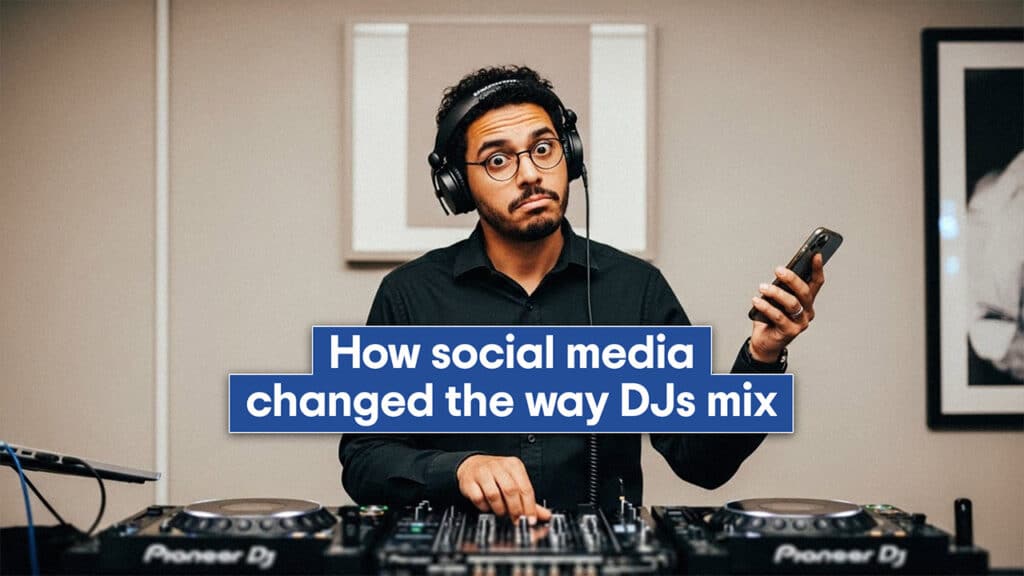
Walk into a lot of clubs today, and you might notice something has changed.
You hear a bit of build up, then the drop comes in, and before you can really settle into the groove, the next track is already coming in. It is frantic and attention grabbing, but this style of mixing leaves behind a lot of what we think makes DJing such a great art form. It can also get exhausting pretty quickly.
A lot of this shift comes down to the influence of social media. While it has created opportunities that were once unthinkable, it has also brought some unintended consequences into real world DJing.
When I asked DJs about it on Reddit, people generally agreed that mixes have sped up and attention spans have dropped. So why is this happening, is it even a problem, and what can we do about it?
How Social Media Rewires DJ Priorities
The highlight reel problem
Social media algorithms reward instant impact. If content does not grab attention within seconds, people scroll past it. It is like watching a movie trailer instead of the full film. You get the explosions and witty lines, but none of the build up that gives them weight. Stretch that kind of pace out, and the experience becomes exhausting.
The clips that blow up on socials are always the flashiest, most eye catching moments. A big transition into a drop. A crowd losing it. The peak of the night compressed into ten seconds.
What you do not see is:
- the context
- the phrasing
- the subtle decisions that actually make the moment land
– u/colorful-sine-waves
It is easy to see why new DJs get pulled into this way of thinking. The clips that blow up are the ones that make you look busiest. You see the hands flying over the mixer and the crowd reaction right on cue. You do not see the half hour of steady, patient mixing that usually sits either side of that one moment.
The pressure to stay “busy”
It is not just social media shaping this. A lot of newer DJs said they mix fast because they feel nervous or worry about looking inactive. When you are behind the decks and feeling restless, it is surprisingly easy to start fiddling just to look engaged.
– u/AssistantPersonal732
The problem is that this pace comes with a cost. The musical journey disappears. A great DJ set takes the dancefloor through peaks and troughs, gives people space to settle into a groove, and builds a sense of story. When every track is cut short, that story never has a chance to develop.
Mixing With Purpose
This is not about saying fast mixing is bad. There is a long and respected tradition of it. DJs have been cutting quickly between tracks since the earliest days. Radio DJs did it. Hip hop turntablists mastered it. Entire styles thrive on fast, high energy transitions.
So speed alone is not the issue. It is about how and why you use it.
When fast transitions are done with intent, they can be electric. When they are done on autopilot or because of nerves, they lose their impact.
Fast mixing is a tool, not a default setting. Use it to lift key moments, not to fill every quiet second.
So how do you bring that impact back?
Practical Ways To Slow Down And Regain Control
Give yourself a moment to deliberately slow down
When you are practising at home and itching to move into the next track, take a step back and imagine how things would feel to a real crowd. They are probably nowhere near as impatient as you feel in that moment. Let the track run a little longer than you normally would and notice how that feels.
Appreciate the extra time
A lot of people admit to over DJing because of nerves or a need to feel like they are constantly doing something. The challenge is learning to be comfortable with stillness.
You can use that space to:
- interact with the crowd
- have a little dance
- spend longer choosing the perfect next track
It can feel surprisingly liberating not to hover over the decks.
Stop mixing for the imaginary camera
Most DJs fall into this without realising it, especially when a camera is pointed at them. If you notice yourself thinking about how a transition will look rather than how it feels in the room, that is your cue to refocus on the actual space around you.
Try the opposite
Take a second to think about the habits you tend to fall into, then try the opposite. If you mix too quickly, hold off. If you always move at the same point in a track, shift it. Breaking habits can reveal new ways to shape a set and remind you that you are not locked into one style.
Let the crowd guide you
This should be obvious, but it is easy to forget in the moment. The crowd is the best reference you have. Most people enjoy settling into a groove for longer than we expect, so pay attention to how the room reacts before deciding when to move on.
- Pick one section of your set where you let every track breathe longer than usual.
- Resist the urge to touch the mixer for at least 32 bars and watch the floor instead.
- Make a note afterwards: did the crowd seem more or less engaged?
Getting Comfortable Behind The Decks
A lot of the pressure behind fast mixing ultimately comes down to confidence. When you feel settled behind the decks, you stop rushing. You stop second guessing yourself. You start choosing tracks that actually fit the room. That is when DJing becomes more creative, more enjoyable, and ultimately more memorable.
If you want to build that kind of confidence, this is exactly what you get when you sign up to Crossfader. You will get a personalised learning journey that guides you through exactly what you need to know, along with three free courses so you can get started right away.
Ready to feel more confident behind the decks?