
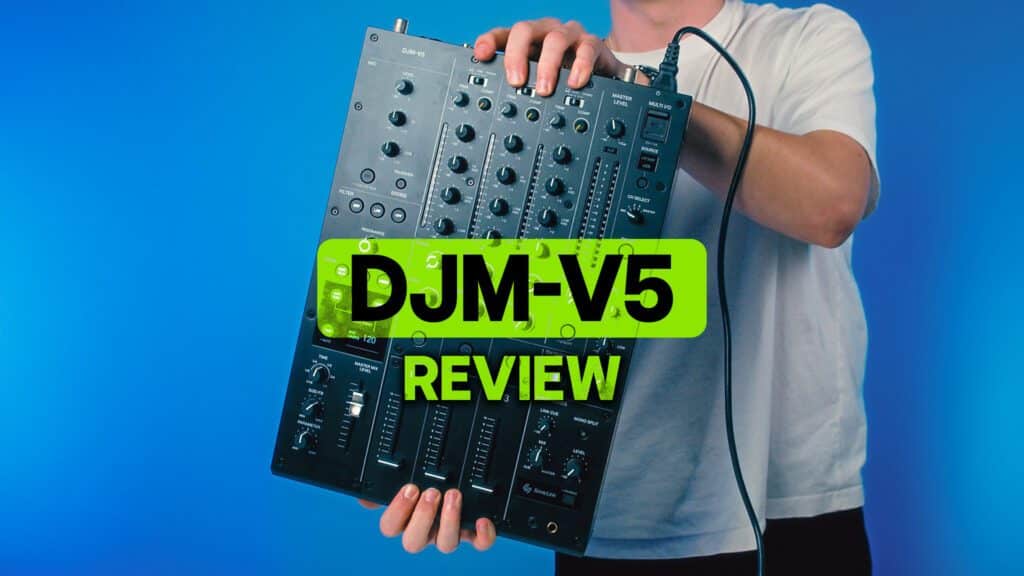
The DJM-V10 sits clear at the top of AlphaTheta’s lineup of club mixers. It’s an absolute beast, speced out with everything you could possibly need including an incredible 6 channels, built-in compressor, 4-band EQ and super powerful effects. For most people though, this was complete overkill and its nearly £3000 price point made sure it stayed a pretty niche bit of gear.
Now though, AlphaTheta have just dropped its baby brother. The new V5 (as the name suggests) is basically half a V10, with an unusual 3 channels but still keeping many of the great features of its older sibling. And at a much more accessible £1,739, this now is going head to head with club-standard mixers like the DJM-A9.
So let’s dive into whether this new mixer is worth checking out.
DJM-V5 Video Review
DJM-V5 Key Points
- Price: £1,739 / €1,999 / $1,999
- Three-channel club mixer
- Long-throw channel faders with adjustable curves
- Per-channel compressor and four-band EQ
- Send-based spatial effects with fader control
Mixer Controls
The headline news for the V5 and the first thing you’ll notice is that three-channel layout. It’s not completely unheard of before, but it’s still highly unusual especially for a major brand to release. At first, it seems a bit odd but it makes sense when you think about it. It’s very rare that you’d need all four channels of most mixers but this still gives you a bit more flexibility than a standard two channel.
At the top of each channel, you’ve got the standard trim and input selection, with options for line, phono, and USB.
Each channel also includes a built-in compressor, carried over from the V10. This was probably brought in as the V10 was partially designed with hybrid performance in mind and would be really useful for things like external drum machines and synths. It still has its place for music, where you might use it on unmastered or quieter tunes to help them fit in.
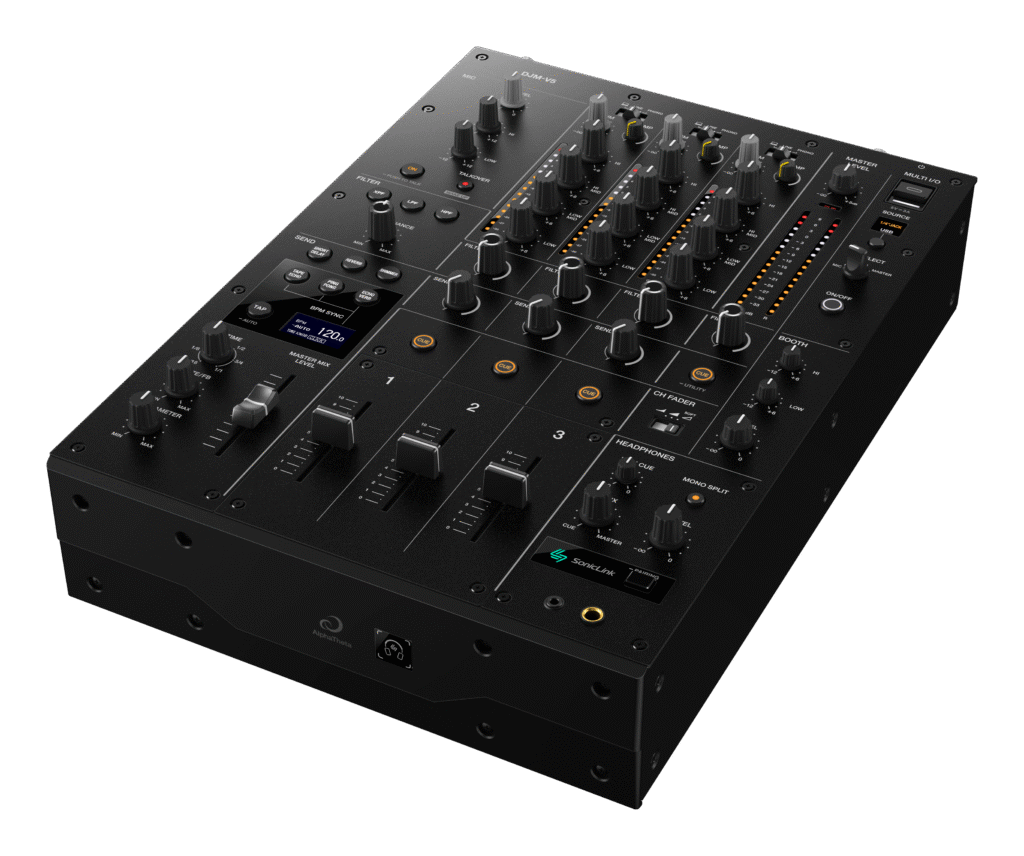
Below that sits the four-band EQ, again taken from the V10. Rather than a single mid control, the mids are split into high-mid and low-mid, alongside the usual highs and lows. That’s handy to give you a little extra precision when you’re mixing if you like really carefully sculpting your sound, but it won’t be to everyone’s tastes.
One of the most noticeable differences compared to other club mixers like the DJM-A9 is the channel faders. They’re a fair bit longer than most faders, which gives you that extra bit of resolution when you’re bringing in new tracks. This will be especially useful if you love long gradual blends.
For these faders, you’ve also got three curve options that affect how they work. You’ve got your standard linear and tapered curves that work as you’d imagine but there’s also a new ‘Soft’ mode, which slightly attenuates the higher frequencies as you fade in giving a smoother sound.
One glaring omission is there’s no crossfader at the bottom. That’s to make room for those long throw faders and AlphaTheta have clearly gone all-in on that slower blending sort of mixing they encourage.
Filter
Each channel on the DJM-V5 has its own filter, and, like on the V10 these are set so that when fully left they’re off and fully right they’re at max, rather than being sweeping either side from the middle, like you get on most club mixers.
This is useful as it gives you a bigger range to sweep through and, crucially, you don’t get that awkward moment where you go to set the filter back to the middle and it’s still slightly on right as a drop hits. The downside however, is that you set the filter mode across all channels, so you can’t have a high-pass on one and a low-pass on another.

You’ve got three filter modes per channel:
- Low-pass
- High-pass
- Cross-pass
The cross-pass filter is the new one here, and it behaves differently to the usual options. As you sweep it, the mids and highs are filtered while the low end stays in place. That means you can pull vocals or melodic content back without losing the kick underneath. The resonance is also adjustable for all of these.
Unlike on most mixers, you also get a filter on the master channel.
FX
The FX section works a bit different to most AlphaTheta mixers, but its pretty easy to wrap your head around.
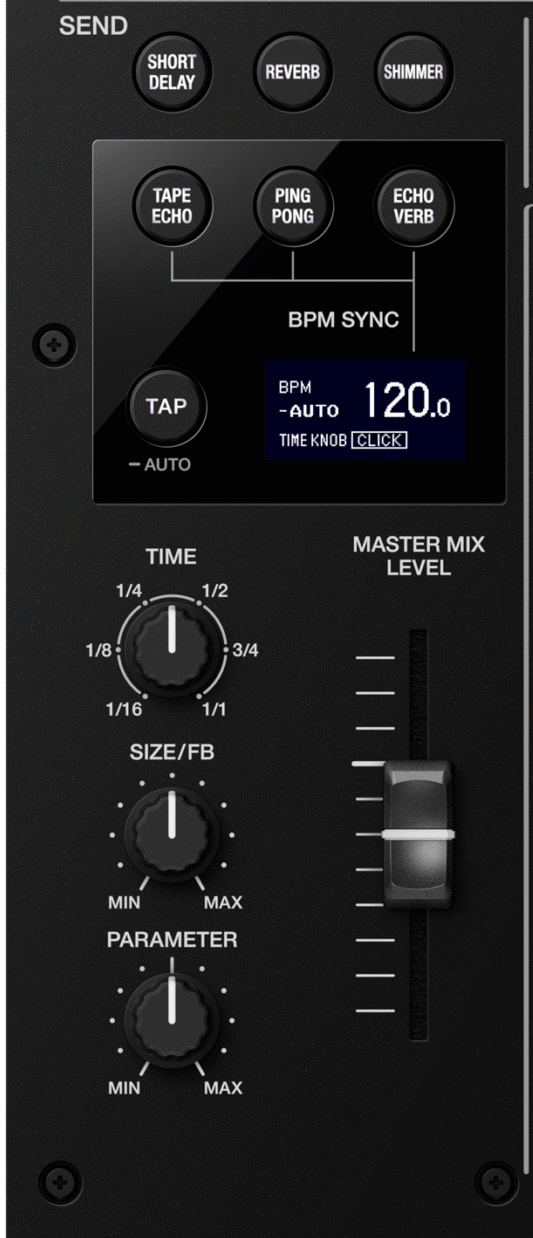
Below the filter is the send control for the effects section. This lets you decide how much of each channel is sent to the FX, from none at all through to the full signal. The effects section sits on the left side of the mixer and focuses on spatial effects. You’ve got:
- Reverb
- Shimmer
- Ping Pong
- Echo Verb
- Tape Echo
Each effect comes with extra parameters to tweak how it behaves, including size/feedback for each and a specific control. There’s also a time control which, unlike the V10, uses stepped values that lock to musical divisions. Tempo can be tapped in manually or matched to the playing track.
Instead of a wet/dry knob, the DJM-V5 uses an effects level fader. Bringing effects in and out on a fader can feel more natural for longer blends, and it fits well alongside the long channel faders on the mixer.
The big loss here compared to the V10 and most other mixers is there’s no Beat FX section. For a lot of DJs, this will instantly disqualify them from ever wanting to buy this mixer but the whole idea was clearly to make a mixer that’s more streamlined and straightforward, especially for DJs who aren’t really using those sorts of effects.
Sound Quality
The DJM-V5 uses much of the same audio output hardware as we’d expect to find on AlphaTheta’s higher-end mixers.
It runs a 96kHz, 64-bit mixing DSP, with 32-bit AD and DA converters from ESS Technology. This is flagship level specs and certainly as good as you’d ever need, with those high-end components giving you loads of headroom, detail and a crystal clear sound, no matter what you’re playing or sound system you’re going through.
Headphones, Booth & Monitoring
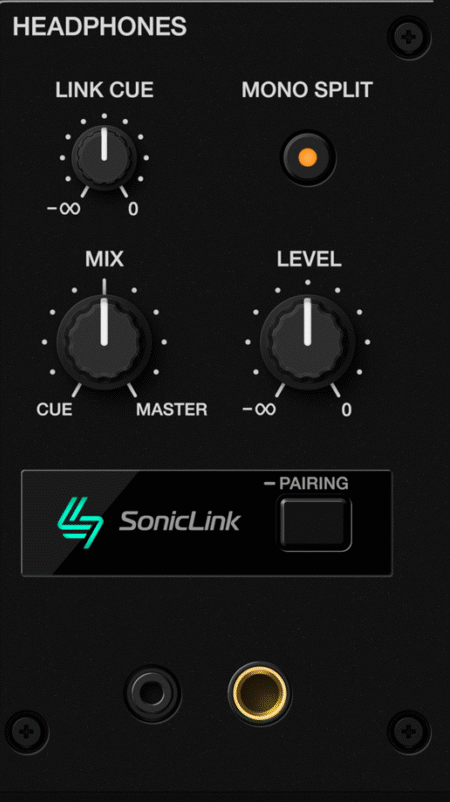
The headphone section is mostly standard, with cue and master monitoring handled in the usual way.
One feature carried over from the V10 is Link Cue, which lets you preview tracks from linked players without loading them into a channel. It’s useful when you’re browsing or checking tracks mid-set and don’t want to tie up a channel just to listen.
The DJM-V5 also includes built-in SonicLink pairing for compatible wireless headphones, which is handled directly with a button and NFC touch point on the mixer. At launch this just works with AlphaTheta’s HDJ-F10 headphones, so it’s really niche at the moment, but we’d expect AlphaTheta to stand to add this to many more headphones in the coming years.
On the monitoring side, the booth output includes its own two-band EQ, giving you separate control over the booth sound without affecting the main mix.
Connectivity & I/O
Around the back, everything is pretty much where you’d expect it to be.
You’ve got line and phono inputs across all three channels, plus USB-C for connecting a laptop or mobile device. The move to USB-C is to be expected with newer AlphaTheta hardware, and the same connection also handles rekordbox and Serato, as well as recording.
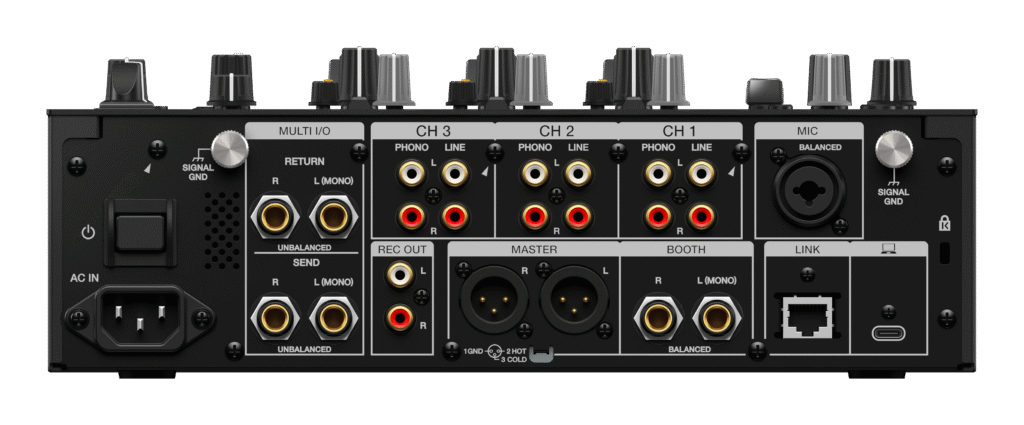
The routing options aren’t as intense as the V10, but if you want to expand beyond the onboard effects, the V5 supports external FX like the new RMX-IGNITE via send and return.
On the output side, there are master and booth outputs, each with independent control. The booth output includes its own EQ, which is useful when the booth sound needs adjusting without affecting what’s going to the main system.
The microphone section sits separately from the main channels and includes a two-band EQ, along with talk-over and push-to-talk controls, but no effects.
Final Verdict
The DJM-V5 keeps a lot of the core DNA of the V10, but whereas that was a beast of a mixer, overwhelming you with countless knobs and options, this feels really sleek and streamlined.
Some things really won’t be for everyone, however. The lack of Beat FX, three channels and no crossfader are design decisions that will certainly alienate a lot of DJs. But if you’re not fussed about those things, and are more into long blends, there’s a lot to love here.
The overall sound quality is absolutely top-tier, with everything being super crisp and clear, and the send FX being a standout feature. The overall build and finish is also faultless as we’d expect.
Price-wise, at £1,739/€1,999/$1,999, it’s hardly cheap, but to put it in context, the V10 costs over a thousand pounds more, so it’s about in line with the rest of AlphaTheta’s lineup. Hopefully, the V5 will see more widespread adoption than the V10 and shake up the supremacy of A9-style mixers.
Yes. The DJM-V5 uses a three-channel layout rather than the more common four channels found on most club mixers.
No. The DJM-V5 does not include a Beat FX section. Effects are handled via a send-based spatial FX section instead.
No. The DJM-V5 does not include a crossfader. This makes room for long-throw channel faders designed for smoother blends.
The DJM-V5 includes Reverb, Shimmer, Ping Pong, Echo Verb and Tape Echo in its onboard effects section.
Yes. The DJM-V5 includes built-in SonicLink pairing for compatible AlphaTheta wireless headphones, such as the HDJ-F10.
At launch, the DJM-V5 is priced at £1,739 in the UK, €1,999 in Europe, and $1,999 in the US.